Burganova Elizaveta
B. 1998
Elizaveta Burganova was born in Moscow in 1998 and now lives and works in Seoul. She creates contemporary graphic works in ink and metal leaf on paper, as well as paintings on canvas where oil or acrylic is combined with metal leaf. Her works are conceived as a direct encounter with the viewer. They do not tell stories or offer predetermined answers — the work becomes complete at the moment when the viewer looks attentively and enters into a personal inner dialogue with the image.
The minimal means in her practice are used not for formal austerity, but for precise sensory impact. She combines traditional materials with metal leaf because its reflective surface changes the perception of the image depending on light, viewing angle, and the movement of the viewer. This material encourages longer looking, returning to the work, and noticing how the image operates differently each time.
Her working process is based on repetition, discipline, and sustained concentration. The line in her works is not an impulsive gesture, but the result of long academic training and memory accumulated in the body. She deliberately removes visual and semantic “clues” so that the work cannot be reduced to a single story or interpretation. Her visual language is formed at the intersection of classical European art education and East Asian aesthetics, where rhythm, pause, and emptiness play an important role.
In a world where attention is constantly captured by external stimuli, she sees art as a way to restore a person’s access to their inner space. She is interested in the moment when the viewer stops “consuming” the image and begins to notice what they feel, what they remember, and what responds within them. For this reason, her works have an open structure. Meaning is not predetermined or dictated by the artist — it forms in the process of perception.
Her practice is not connected with social or political statements and is not built around a specific artistic persona. The “message” of the work is closer to an invitation: to pause, slow down, and reconnect with oneself. She does not set a fixed narrative. The same image reveals itself differently each time because the viewer brings their own experience, memory, and present state into it. In this sense, the viewer is not an external observer but an essential part of the work.
The early stage of her practice was associated with a denser visual language. Her graphic works contained more color and decorative elements, striving for visual “fullness.” However, over the past year, changes in her life context and way of thinking led to a clear shift in her work.
Living in the social environment of Korea, she became especially aware of the constant flow of external information: urban noise, intense traffic, conversations and music, as well as the demanding rhythm of daily life connected with family and raising a child. In these conditions, she began to notice how her own thoughts and desires gradually blurred, as if dissolving into the surrounding noise. This experience directly influenced her practice, and she consciously began to remove everything unnecessary, leaving only what is essential.
At this new stage, her works become spaces of personal concentration. It is important for her that the viewer can momentarily step out of the state of constant reaction to external signals and return to what they truly think and feel. The simplification of form here is not a stylistic move toward minimalism, but a way of creating a “space” — an emptiness in which an individual, attentive, and direct encounter with the image becomes possible.
CONTACT
T. +821083329525
6951036@gmail.com
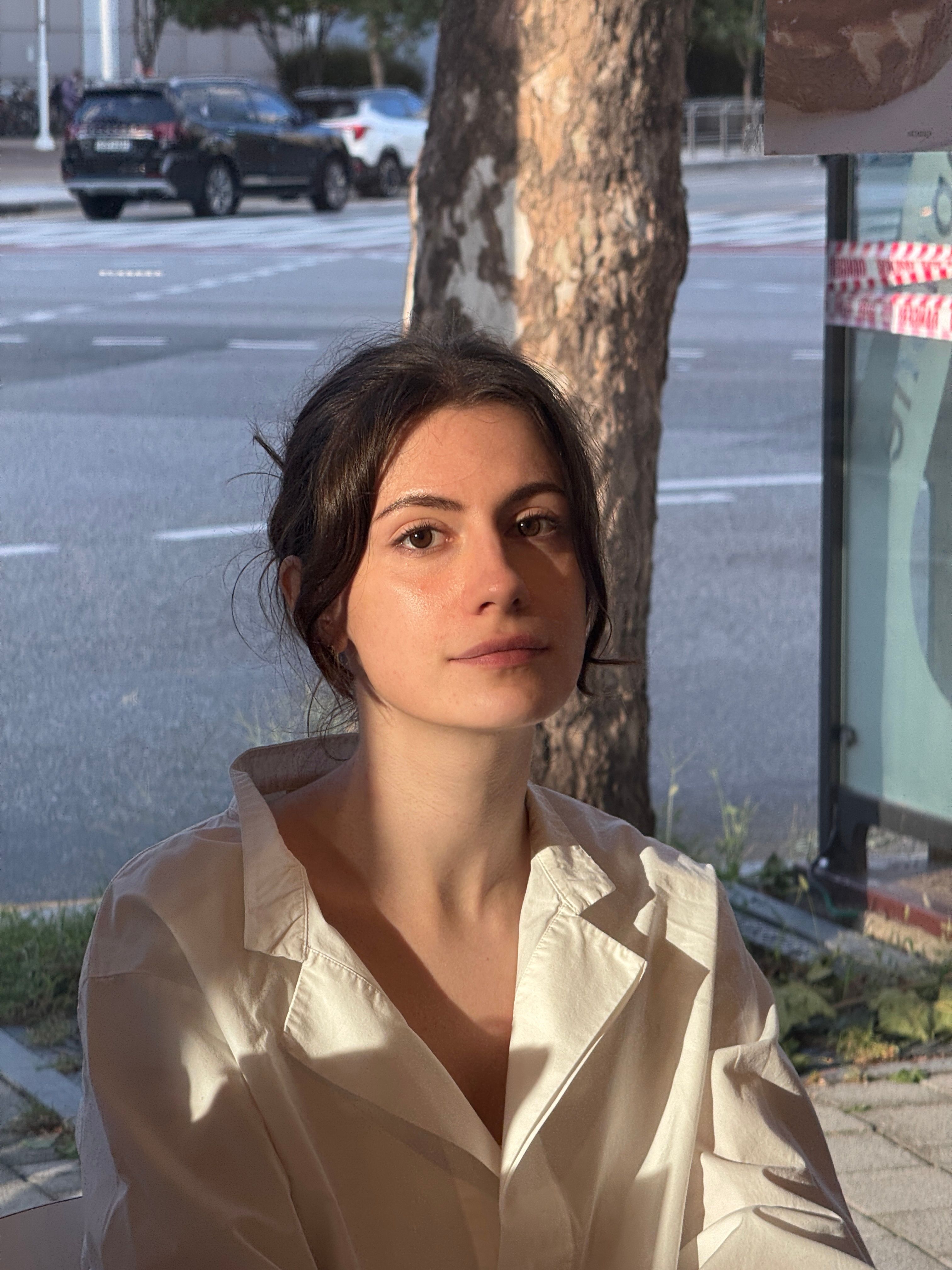
Burganova Elizaveta
B. 1998
Elizaveta Burganova was born in Moscow in 1998 and now lives and works in Seoul. She creates contemporary graphic works in ink and metal leaf on paper, as well as paintings on canvas where oil or acrylic is combined with metal leaf. Her works are conceived as a direct encounter with the viewer. They do not tell stories or offer predetermined answers — the work becomes complete at the moment when the viewer looks attentively and enters into a personal inner dialogue with the image.
The minimal means in her practice are used not for formal austerity, but for precise sensory impact. She combines traditional materials with metal leaf because its reflective surface changes the perception of the image depending on light, viewing angle, and the movement of the viewer. This material encourages longer looking, returning to the work, and noticing how the image operates differently each time.
Her working process is based on repetition, discipline, and sustained concentration. The line in her works is not an impulsive gesture, but the result of long academic training and memory accumulated in the body. She deliberately removes visual and semantic “clues” so that the work cannot be reduced to a single story or interpretation. Her visual language is formed at the intersection of classical European art education and East Asian aesthetics, where rhythm, pause, and emptiness play an important role.
In a world where attention is constantly captured by external stimuli, she sees art as a way to restore a person’s access to their inner space. She is interested in the moment when the viewer stops “consuming” the image and begins to notice what they feel, what they remember, and what responds within them. For this reason, her works have an open structure. Meaning is not predetermined or dictated by the artist — it forms in the process of perception.
Her practice is not connected with social or political statements and is not built around a specific artistic persona. The “message” of the work is closer to an invitation: to pause, slow down, and reconnect with oneself. She does not set a fixed narrative. The same image reveals itself differently each time because the viewer brings their own experience, memory, and present state into it. In this sense, the viewer is not an external observer but an essential part of the work.
The early stage of her practice was associated with a denser visual language. Her graphic works contained more color and decorative elements, striving for visual “fullness.” However, over the past year, changes in her life context and way of thinking led to a clear shift in her work.
Living in the social environment of Korea, she became especially aware of the constant flow of external information: urban noise, intense traffic, conversations and music, as well as the demanding rhythm of daily life connected with family and raising a child. In these conditions, she began to notice how her own thoughts and desires gradually blurred, as if dissolving into the surrounding noise. This experience directly influenced her practice, and she consciously began to remove everything unnecessary, leaving only what is essential.
At this new stage, her works become spaces of personal concentration. It is important for her that the viewer can momentarily step out of the state of constant reaction to external signals and return to what they truly think and feel. The simplification of form here is not a stylistic move toward minimalism, but a way of creating a “space” — an emptiness in which an individual, attentive, and direct encounter with the image becomes possible.